Q&A Vol. 2: More Questions About Multimedia Localization
What does Loc & Capture actually work on beyond video? What does multimedia QC include? And what happens when the text is baked into the asset?

Resources / Content library
Explore our latest videos, articles, and insights on multimedia localization, creative adaptation, QC, and global content workflows.
Featured video
Remember that "coming soon"? Turns out when we say soon… we mean it. New look, new navigation, the same obsession with detail as always. We hope you enjoy navigating it as much as we enjoyed creating it And yes, there are stickers. (Find them!)
News 0:23
See moreWhat does Loc & Capture actually work on beyond video? What does multimedia QC include? And what happens when the text is baked into the asset?
A quick look at how fly.qc combines cloud-based project management with local media analysis to make QC easier for heavy video workflows.
A World Cup game asset showed why visual context matters in global content. A stadium can be rendered beautifully and still feel wrong if the place behind it does not make sense.
A second look at how fly.qc helps teams review localized video assets beyond manual playback, checking visual consistency, technical specs, and on-screen text against the reference.
A quick look at how fly.qc helps teams review localized video assets faster, catching visual, technical, and on-screen text issues earlier in the workflow.
A World Cup highlights graphic showed how even a clean, polished asset can fail when the information behind it is handled without context.
Some problems are so specific that the only reasonable answer is to build your own tool. That is pretty much how LEDroom happened. Our CEO, Oscar, explains how we use it to build LED campaigns for stadiums, turning repeated structures into something we can adapt faster, cleaner, and with way more control. A very specific challenge. A very Loc&Capture way to solve it.
During England vs. New Zealand, a stadium lineup graphic became the screenshot people remembered. A short look at names, live sports assets, and why final QC matters.
A World Cup graphic showed why multimedia QC is not only about spelling. Sometimes the word exists, but it still does not fit the audience, the format, or the moment.
Remember that "coming soon"? Turns out when we say soon… we mean it. New look, new navigation, the same obsession with detail as always. We hope you enjoy navigating it as much as we enjoyed creating it And yes, there are stickers. (Find them!)
What if QC did not mean checking files one by one? In this short video, we explain the core idea behind fly.qc, Loc & Capture’s quality-control platform for audiovisual localization. Built to help teams review an entire batch at once, fly.qc supports earlier validation of visual consistency, technical specifications, and on-screen text against the reference. The result is less manual effort, faster review, and a smoother, more controlled workflow for multilingual audiovisual projects.
Three of the questions we hear at every event, answered in one video. Learn what multimedia localization involves, where translation fits into the process, and why adapting content is never just copy and paste.
A quick look at how Loc & Capture adapts global ad creatives for stadium LED boards, making sure logos, text, animations, and brand messages stay clear, readable, and on-brand in live sports environments.
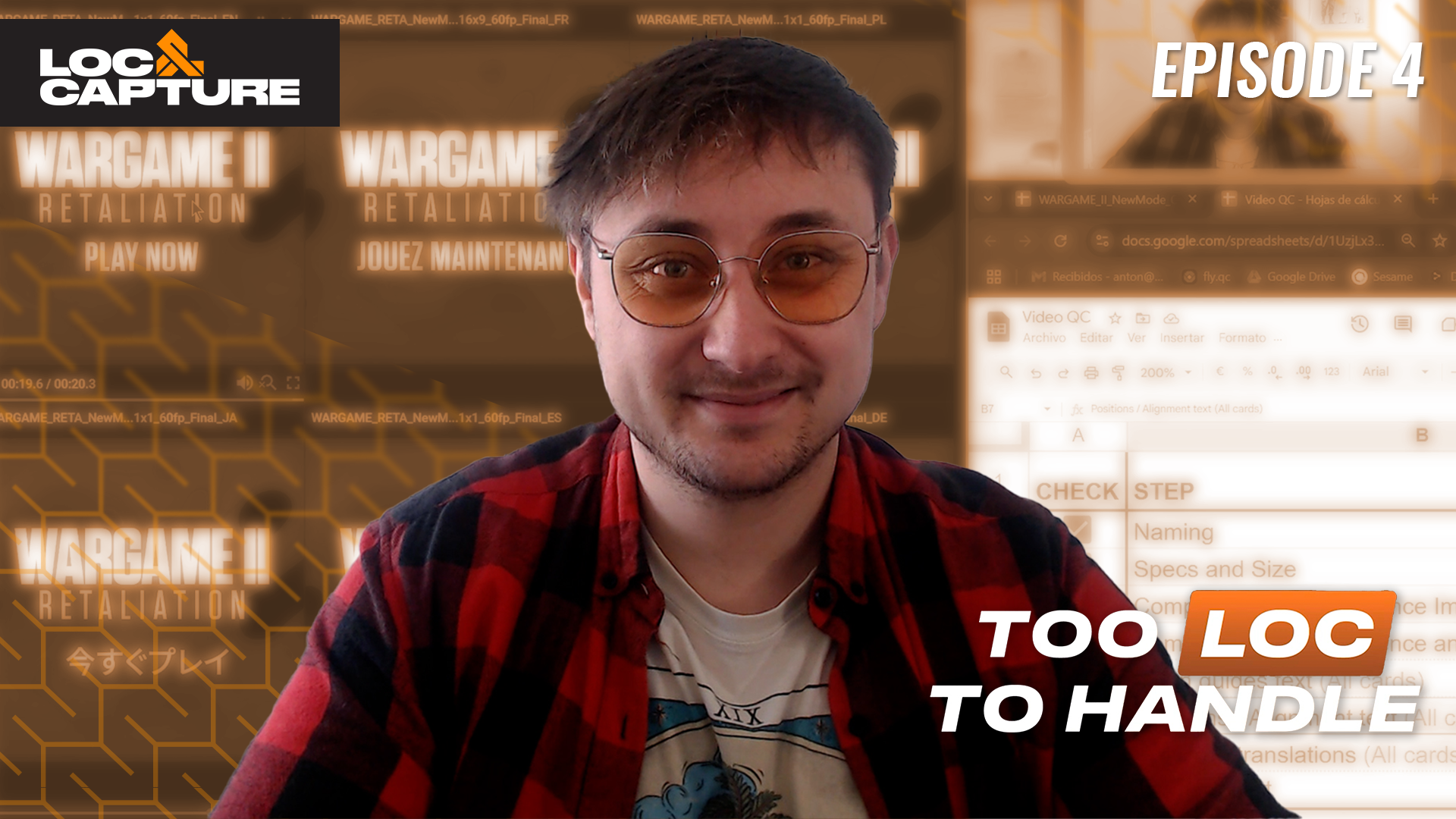
When a full batch of game content lands, “looks fine” is not enough. In this episode of Too Loc To Handle, our colleague Antón runs QC on videogame content with real translations using our in-house tool, fly.qc. The goal is to catch the details that only appear when localized content is reviewed in context, not just inside a spreadsheet. Because passing a spellcheck and working inside the game are two very different things. fly.qc helps us close that gap at scale.
Some shots don’t sit still, and neither does the interface you have to place on top. In this episode of Too Loc To Handle, Javi works on a project where a UI had to be integrated into a moving shot and then localized. That means tracking the movement, placing the interface so it feels natural in the scene, and making sure everything still works when the text changes language. It’s the kind of challenge where layout, motion, timing, and localization all need to behave together. A very specific problem. A very Loc & Capture way to solve it.
Missing fonts are one of those small production problems that can quickly turn into a very real localization challenge. In this episode of Too Loc To Handle, Antonio adapts an image into several languages without access to the original source file. That means working around technical limits, rebuilding what is needed, and keeping every version visually consistent. Because when the source file is missing, localization is not just about replacing text. It becomes a careful balance between design, layout, and production problem-solving. A classic issue. A very Loc & Capture way to handle it.
Some localization problems start before the content ever reaches another language. In the first episode of Too Loc To Handle, Pablo breaks down a real videogame localization project and shows one of the most common mistakes in video and image adaptation: treating localized assets as simple text swaps. When timing, layout, design, and context are ignored, even a correct translation can stop working on screen. A real project, a common problem, and the kind of production thinking that keeps multilingual content consistent.
Reach out and let's talk about your next launch.